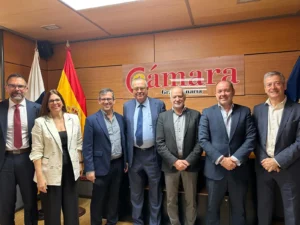
Article published by Mr. José Carlos Francisco in the January issue of La Gaveta Económica*.
The first thing we must clarify is what we understand (or understand) by future in this article. Normally, people expect a story similar to science fiction, in the style of Jules Verne or “Star Wars.” Others, less futuristic, think of a closer future, where robots, sensors, artificial intelligence, biotechnology and nanotechnology transform our lives and cities. Let's say that the former think in centuries and the latter in a gradual introduction of technologies, the combination of which will transform society until making it very different over the course of a few decades. My domestic future has a lot to do with the conception that the “future is already here.” It is based on technologies that exist, social phenomena and political movements evident in the present, and more or less transparent trends that have already begun their path.
The vision of what awaits us and, above all, how to approach it is not homogeneous. Each person's psychology is different. Optimists believe that technology will solve our limitations, as it has generally done in the past, and pessimists only see inevitable risks in pollution, overpopulation, water scarcity, and moral, social, and institutional deterioration. But the relevant issue is that each has a different perception of how the challenges and decision-making should be addressed, which make up a specific sociology on the islands, and even different depending on which island we are talking about. For example, the vision of the economy in La Palma is very different from Gran Canaria, etc.
Some ideas installed in the common Canarian ideology abound and have media echo and, therefore, political influence, which wreak havoc on economic dynamization and job creation. Some ideas are not exclusive to our field, but I will refer to them because their extension and roots in our environment affect us uniquely and impact the necessary adaptation to the future.
As long as the legislative maelstrom prevails and the mandarins are the supreme masters of its practical interpretation, the deadlines of the projects will be lengthened and will be incompatible with the short cycle of the new economy. It is enough to look at the data to understand that the stock of laws and regulations, as well as their rate of growth, are unacceptable and unmanageable. There is always a rule that prevents doing anything and even if there is another that allows it, the mandarin will always use the first, since he has learned that “no” is socially accepted and “yes” is suspected of dark interests and a candidate to end up in criminal courts. To the extent that new technologies require new inevitable regulations, the maxim: “for every new law, two repealed” becomes more necessary. At the same time, the very long period to implement new projects will become increasingly critical, since the business cycle immersed in the new economy is much shorter. Birth, growth, maintenance and disappearance will constitute much narrower cycles. You die sooner and you triumph sooner. With cycles like the current ones, during the process
of administrative processing that lasts five, ten and fifteen years, many brilliant ideas will fall by the wayside.
Another fact that limits future perspectives is the conception of the supremacy of the public over the private. This is manifested in the conviction that Public Administrations at all levels and particularly in the Town Councils, have in their hands the magic wand to decide what needs to be done, where and how. Fortunately, “The Land Law” has represented two important milestones, since it eliminated four pre-existing laws and eliminated the need for the so-called territorial island plans, which make up an indecipherable gibberish of sectoral and territorial regulation. We must understand that the corset of excessive and detailed planning, hunts badly with a world in constant change and acceleration.
Finally, from a global perspective, another mantra will impact our future. The general opposition to new ideas and projects is a very worrying constant for development. A new public infrastructure, a new private project, always has a cohort of opponents with a broad social echo that paralyzes development, in a kind of counterproductive immobility.
Despite all resistance, the future is inevitable and will affect our lives whether we like it or not.
U!
(*) This article is part of the author's new book, still in development.