Economic inequality is a persistent phenomenon that affects millions of people around the world. It is not only reflected in income, but also in consumption capacity, savings rates and the accumulation of wealth over time. Understanding these dynamics is key to designing strategies that reduce household financial vulnerability and promote more equitable growth.
Wealth accumulation and savings flows
The wealth of a household is built from savings, that is, from income that is not allocated to consumption. When a household spends more than it earns, it must resort to selling assets or borrowing to finance itself, which can be an indicator of economic difficulties. On the other hand, a savings rate close to zero means that the household has no room to face unforeseen events or to improve its long-term financial situation.
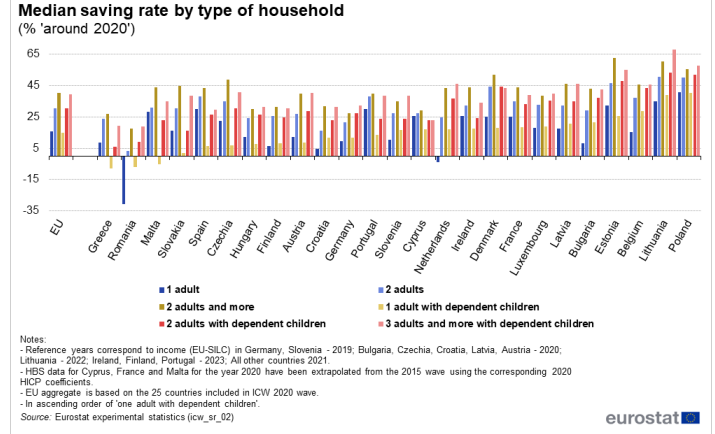
In the European Union, the median savings rate has increased in recent years, going from 21% in 2015 to 26% in 2020. However, there are exceptions such as Finland, France and Romania, where the saving capacity has decreased, evidencing the economic fragility of some sectors of the population.
Inequality in income, consumption and savings
To measure inequality, the Gini coefficient is used, which shows how equitably resources are distributed in a society. While income and consumption have coefficients ranging between 27 and 47 in EU countries, wealth inequality is significantly higher, with values ranging from 46 to 72.
Savings are also a factor of inequality: higher-income households have higher savings rates, allowing them to increase their wealth over time. In contrast, families with less income must allocate most of their income to essential goods and services, without the possibility of saving. In countries such as Romania, the Netherlands and Greece, the first income quintile has negative savings rates, indicating serious financial vulnerability.
The relationship between poverty and consumption
Analysis of the interaction between income and consumption indicators reveals that some people not only have low incomes, but also must severely restrict their consumption. In 2020, 24% of the EU population was at risk of poverty due to insufficient income or extremely low consumption levels. In countries such as Spain, Latvia and Estonia, this figure was close to 30%.
Despite this reality, the percentage of households that simultaneously have negative savings rates and low consumption levels is relatively small, standing at around 2.1% in the EU. However, in Romania this figure rises to 7.5%, while in Spain it reaches 3.1%.
The life cycle of savings
Saving behavior varies depending on age and household structure. Young people and retirees tend to have lower savings rates, while adults in their active working years tend to save more. Furthermore, single-parent households with children have greater difficulties generating savings, reflecting the need for support policies for these groups.
Fountain: EUROSTAT
U!