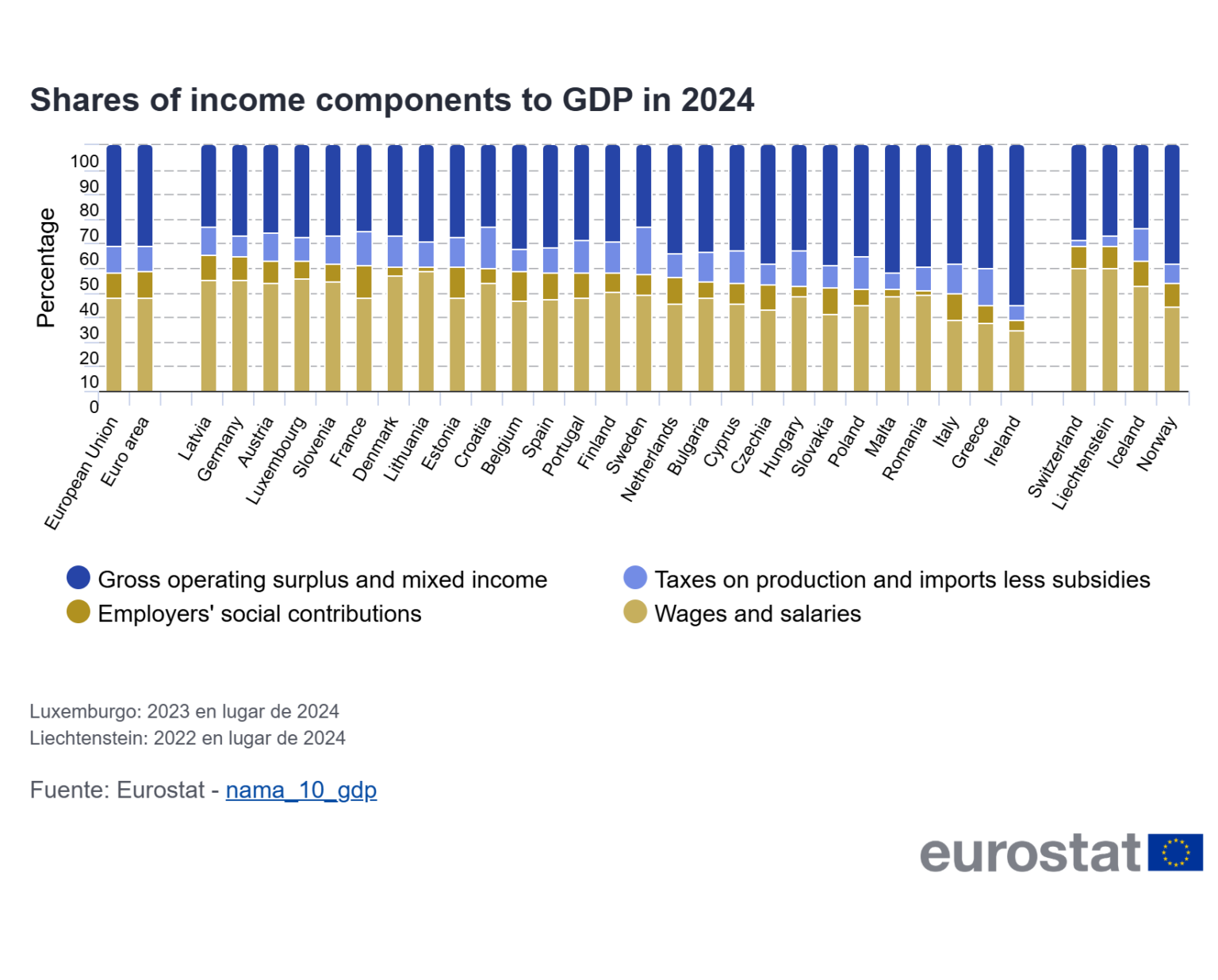
In 2024, compensation of employees was the main component of income in the European Union (EU), representing 47.9% of GDP and 48.5% in the eurozone. This represented an increase of 0.9 and 0.8 percentage points (pp) respectively compared to 2023.
Fourteen countries surpassed the EU average on this indicator, with Latvia (55.4%), Germany (54.5%) and Austria (52.9%) leading the way. In nine countries, this component represented more than half of GDP. At the opposite extreme, Ireland recorded the lowest proportion (28.5%), due to the effects of globalization on its economy.
Taxes on production and imports (less subsidies) rose to 11.2% of GDP in the EU, with Sweden (19.5%) and Croatia (16.9%) at the highest levels. On the other hand, gross operating surplus and mixed income, which reflect business profits and self-employed income, decreased to 40.9% in the EU and 40.7% in the eurozone, with decreases of -1.3 pp and -1.2 pp respectively.
Over the last 20 years, the share of employee compensation in GDP has grown in the EU (+1.3 pp) and in the eurozone (+1.6 pp). Latvia (+15.6 pp) and Lithuania (+10.9 pp) recorded the biggest increases, while Ireland saw the biggest drop (-9.5 pp). In the same period, the ratio of salaries to wages also increased in the EU (+1.8 pp) and in the eurozone (+1.9 pp), while employers' social contributions decreased slightly.
Regarding taxes on production and imports, their weight in GDP has fluctuated in the last two decades, with decreases during the 2008-2009 crisis and the COVID-19 pandemic, although in 2024 it has not yet recovered pre-pandemic levels. For its part, the proportion of gross operating surplus and mixed income, after an increase between 2020 and 2023, decreased in 2024 to levels similar to those of 2020, reflecting changes in the income structure of the European economy.
Fountain: EUROSTAT
U!