Inflation is an economic phenomenon that directly impacts the purchasing power of citizens and the stability of the markets. In the last decade, the European Union has experienced a significant evolution in consumer prices, going from inflation rates close to zero to historical highs, driven by various economic and health crises.
A decade of changes in inflation
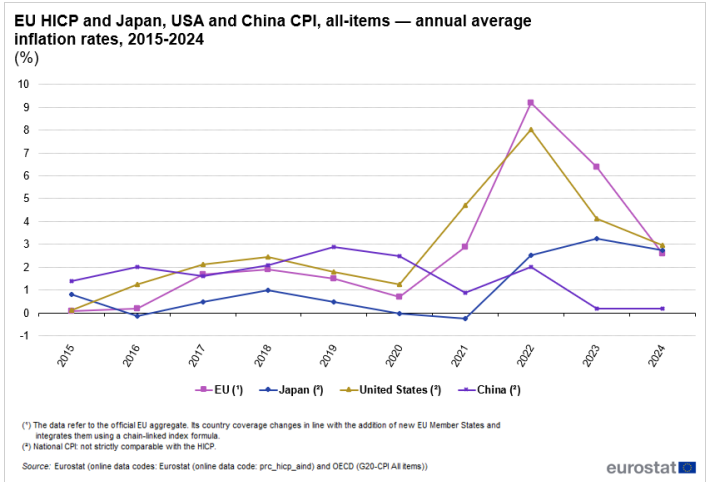
In 2015, inflation in the EU was at a low of 0.1%, reflecting a period of stability following the global financial crisis. However, in the following years, the rate began to gradually rebound: 0.2% in 2016, 1.7% in 2017 and 1.9% in 2018. In 2019, there was a slight drop to 1.5%, and in 2020, with the COVID-19 pandemic, inflation fell to 0.7%, due to the contraction in demand and confinement measures.
However, the situation changed dramatically in 2021, when inflation rose to 2.9%, driven by economic recovery and supply chain disruptions. In 2022, the energy crisis and the geopolitical context caused a record increase of 9.2%, the highest rate recorded in the recent history of the EU. In 2023, inflation fell to 6.4%, still above the 2021 level, and in 2024 it stabilized at 2.6%.
During the period 2015-2024, the EU Harmonized Consumer Price Index (HICP) accumulated a variation of 30.2%, with an annual average of 3.0%.
Global comparison: how did other economies perform?
If we look at the evolution of prices worldwide, significant differences between regions stand out. While the EU recorded an annual average of 3.0%, Japan experienced a much more moderate growth of 1.1%. In contrast, the United States had an average inflation of 3.2%, slightly higher than Europe, while China maintained a rate of 1.6%.
Domestically, the countries with the largest increases in the HICP between 2015 and 2024 were Hungary (66.6%), Estonia (55.1%) and the Czech Republic (51.9%). At the opposite extreme, Cyprus recorded the smallest increase, with 17.1%.
Inflation in 2024: which countries and sectors were most affected?
In 2024, Romania topped the list with the highest annual inflation in the EU, with a 5.8% increase in consumer prices. Belgium (4.3%) and Croatia (4.0%) also recorded high rates. In contrast, Lithuania (0.9%), Finland (1.0%) and Italy (1.1%) were the countries with the lowest inflation.
By sector, prices of alcoholic beverages and tobacco experienced the largest increase in 2024 (5.6%), followed by restaurants and hotels (5.2%) and education (4.9%). Instead, communications was the only sector with a drop in prices, recording a decrease of 1.4%.
Over the last decade, food and non-alcoholic beverages were the categories with the highest cumulative increase in the EU (42.8%), followed by alcoholic beverages and tobacco (41.6%). In contrast, the price of communications decreased by 4.3% in the same period.
Fountain: EUROSTAT
U!