Article published by Mr. José Carlos Francisco in La Gaveta Económica in the April 2017 issue.
Some readers ask me why, being a professional economist, I talk so much in these pages about excess legislation, environmental and territorial regulations, and other matters, which seem more typical of the field of law, in which I am supposed to have, at most, the competence of a “dryland lawyer.”
The reason is that the functioning of public institutions, the quantity and quality of legislation, their interpretation by the judiciary and the application of regulations by officials, has a major impact on the economic and social development of countries, regions and cities.
For example, many renewable energy, regasification, hotel, tourist leisure, etc. projects have long ago resolved the fundamental economic issues: the existence of sufficient demand and the capacity to finance their execution. However, after five, ten and even fifteen years later, they are still waiting for the relevant authorizations to invest and create jobs. From which it follows that the problem is not economic, but institutional.
In other articles I have told some true stories in this regard, such as the case of the black beetle, the mediocre active inoperatives and the “antis”. On this occasion I want to share with you my experience in processing licenses to start up new businesses, from which I have inferred my theory of the circular administrative file (EAC).
A license is usually the consequence of a process of authorizations, reports from different administrations and organizations that give rise to an authorization. Obviously, the opening license is usually the last of the licenses, because there are others previously.
One assumes that this process is linear. That is, stages are overcome until reaching the top of the license. In practice, far from linear, we are in the Canary Islands, in the presence of what we call a circular process, since overcoming a phase does not ensure that we will not have to return to it and start over. It's like that "go back to square one" game, nice, if not because many businessmen have already decided that they don't play that game.
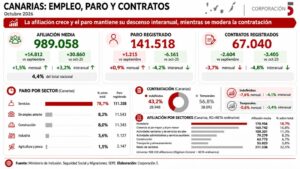
With this confusing and complex framework, the Canary Islands economy has shown that it can generate more than 20,000 jobs per year, when the environment is favorable, a fact that allows unemployment to be reduced gradually, but never to moderately acceptable figures. If we want to one day return to unemployment rates of 10-12 percent, the institutional framework will have to be improved and that is why economists have to worry a lot about these issues, apparently far from our economic “science.”