The economic outlook in the Eurozone and the EU continues to present a mixed picture. While some sectors show promising growth, others struggle with declines and uncertainty.
Growth and Stability Amid Challenges
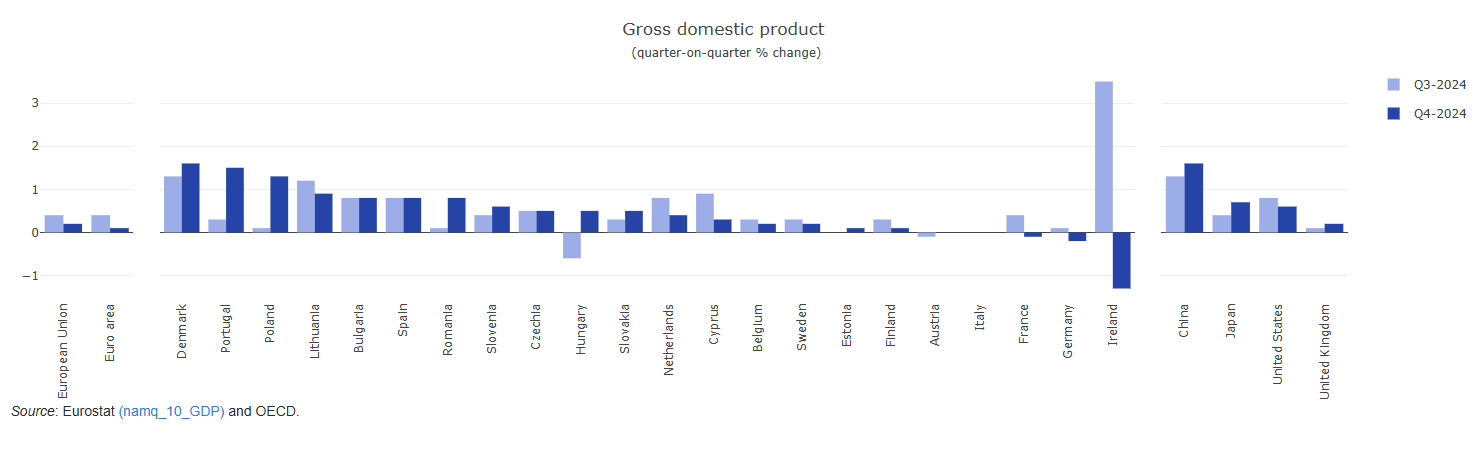
In the fourth quarter of 2024, seasonally adjusted GDP rose modestly by 0.1% in the Eurozone and 0.2% in the EU, after a stronger increase of 0.4% in the previous quarter. In annual terms, GDP grew by 0.9% in the Eurozone and 1.1% in the EU, reflecting general resilience despite obstacles. GDP increased in 17 EU countries, remained stable in 2 and decreased in 3. The growth in Denmark (+1.6%), Portugal (+1.5%) and Poland (+1.3%) stood out, while Ireland (-1.3%), Germany (-0.2%) and France (-0.1%) recorded falls.
Sectoral Inequalities: Construction on the rise, industry on the decline
In December 2024, industrial production decreased by 1.1% in the Eurozone and 0.8% in the EU, reversing November gains. Meanwhile, the construction sector remained stable in the Eurozone and grew in the EU, giving a boost to economic confidence.
Inflation Rises Again
After reaching a low of 1.7% in September 2024, annual inflation in the Eurozone rose to 2.5% in January 2025, while in the EU it rose to 2.8%. Energy prices played an important role in this change, returning to positive levels after months of decline. In January 2025, Hungary (5.7%), Romania (5.3%) and Croatia (5.0%) had the highest inflation rates, with Denmark recording the lowest (1.4%).
Labor Market and Employment Trends
The labor market showed a slight increase in unemployment, reaching 6.3% in the Eurozone and 5.9% in the EU in December 2024. The lowest unemployment rates were in the Czech Republic (2.6%), Malta and Poland (3.0%), while Spain (10.6%) and Greece (9.4%) led the highest. Despite this, employment expectations have improved, with companies anticipating more hiring in the construction and services sectors.
Economic Sentiment and Outlook
The economic sentiment indicator in January 2025 showed a balance, with increases in 14 countries and decreases in 12. The largest increases were in Malta (+5.8) and Luxembourg (+5.1), while the largest decrease was in Slovakia (-3.9). Germany recorded the lowest index (88.1) and Greece the highest (108.6).
Situation in the Largest Economies of the EU
Among the largest EU economies, Poland led GDP growth (+1.3%), while Germany and France recorded slight declines. The highest annual inflation was observed in Poland (4.3%) and the lowest in Italy (1.7%) and France (1.8%). Spain had the highest unemployment rate (10.6%) and Poland the lowest (3.0%). Economic sentiment improved in most of these economies, with Spain reaching the highest index (104.4) and Germany the lowest (88.1).
Fountain: EUROSTAT
U!