
The process of economic convergence in the Canary Islands
With the preparation of this work, Corporación 5 aims to analyze how the process of convergence or divergence experienced between the different autonomous communities of Spain has been between 2000 and 2016, with special attention to the case of the Canary Islands.
CONCLUSIONS I
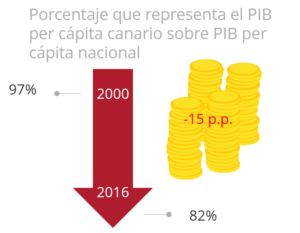
- The Canarian economy has experienced a process of moving away from the average since 2000 in relation to national per capita income.
- In it 2000, the GDP per capita of the Canary Islands represented97% of the national, reducing to 82% in 2016. In just 16 years there has been a loss of 15 percentage points.
- The Canary Islands have not known how to convert demographic growth into value creation.
- The Canary Islands are the only poor region in Spain that has worsened its per capita income since 2000.
CONCLUSIONS II
- They are observed two stages well differentiated in the convergence process between the Spanish Autonomous Communities: reduction in inequality between 2000 and 2009 and increase between 2009 and 2016.
- The difference between per capita income in the Canary Islands and in Spain has gone from 700 to 4,300 euros between 2000 and 2016.
- For the first time, after the crisis, the Canary Islands have begun the recovery process a year behind Spain.
- Unlike the general trend in Spain, the Canary Islands diverged from the average until 2009 and did so at a dizzying pace.
- The Canary Islands divergence process It is explained to a greater extent by the evolution of the population than by the evolution of GDP.
- The divergence in per capita income between the Canary Islands and Spain until 2009 it depended almost in the same proportion of the behavior of GDP than of demographics. As of 2009, it is almost solely due to demographic developments.
REPORT
For more information, access the full report here: